Compilation of news and analysis, including of the ongoing social emergency in post-hurricane Puerto Rico, A Socialist In Canada, Nov 19, 2017
Long-term economic effects of global warming could be far greater than thought
By Michael LePage, New Scientist (UK weekly), Oct 25, 2017 (print edition of Oct 28, 2017)
It is hard to keep up. First, Hurricane Harvey deluged Houston, then Irma left a trail of destruction through the Caribbean and Florida, followed by Maria. All the while, wildfires have been raging in California and elsewhere.

Things got even more extraordinary when Ophelia turned into a major hurricane further east in the Atlantic than any other storm on record has. As it hit Ireland, it blew smoke from wildfires in Portugal over the UK, turning the skies apocalyptic red.
While these events dominated Western media, there is plenty going on elsewhere. In August, unprecedented flooding in India and Bangladesh affected 40 million people.
“The impacts of climate change are no longer subtle,” says Michael Mann of Penn State University. “The last month and a half has been an exclamation point.”
These disasters are causing much suffering and misery. They are also hurting countries’ economies, which has an indirect effect on everyone, even those outside the disaster paths.
Almost every nation agrees that we can’t afford not to limit further warming. That’s why they signed up to the Paris climate agreement. But just how bad will the effect on the global economy be, and how much should countries spend now to limit the economic fallout? Some recent studies suggest we are wildly underestimating the long-term damage – perhaps by a factor of 100.
The headline figures are bad enough. It is estimated that hurricanes Harvey, Irma and Maria could cost the US alone over $400 billion. Globally, this could be the worst year ever for insurers.
Those are the estimates – the actual costs could be much higher. In 2013, Solomon Hsiang at the University of California, Berkeley, and his colleagues used detailed data from the Philippines to find out how families coped in the two years after a typhoon. They found that the actual economic costs were about 17 times as much as estimates made at the time of the disaster. What’s more, there was also a big rise in infant mortality, presumably because families were struggling.
But this doesn’t give the full picture. “The flip side of cost is investment,” says economist Gernot Wagner of Harvard University. “Hurricane clean-up may even add to GDP in some circumstances.”
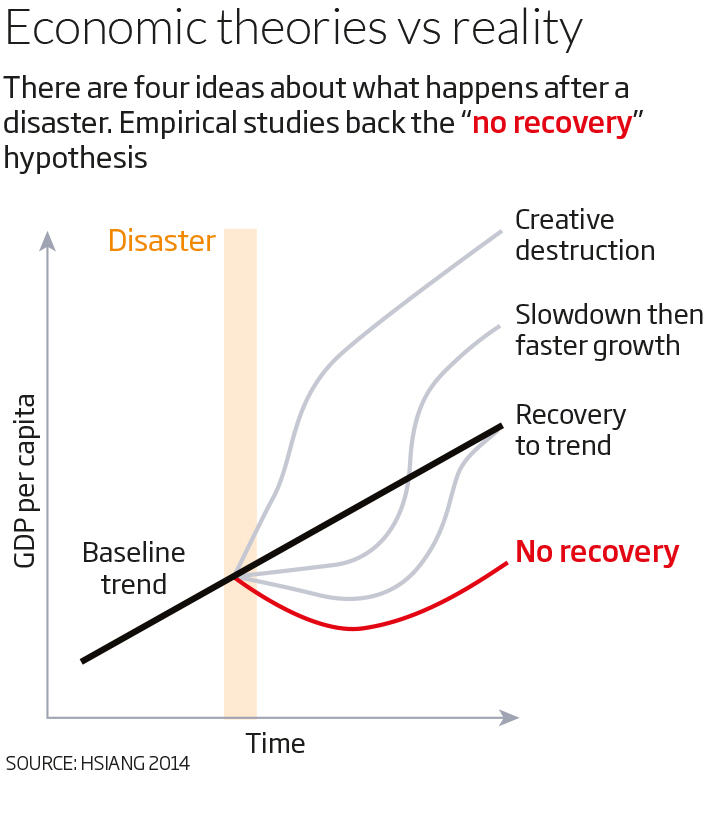
In other words, if lots of money is poured into recovery efforts, a region could bounce back from a damaging storm and end up better off (see Economic theories vs reality). “The strong idea that disasters should be good for growth stopped people looking into this,” says Amir Jina at the University of Chicago.
The few studies that have looked at the evidence concluded that tropical storms don’t affect economic growth. Today, the most widely used economic models used to forecast the effects of climate change all assume that extreme weather events have no long-term effect on growth.
But when, in 2014, Jina and Hsiang took a more detailed look at the growth of countries hit by the nearly 7000 tropical storms since 1950, they did find an effect: growth rates were lower for the next 15 years.
This is crucial, because anything that affects growth rates can have a massive impact over the long term. Twenty years after a severe storm hits, for instance, a country’s per capita incomes may be 7 per cent lower. That’s comparable to the losses from a banking crisis.
No sign of bounceback
“Looking at the relationship empirically shows that we might be underestimating the climate effects by a potentially large degree,” says Jina. Previous studies missed this because they were too simplistic, he says. For instance, they just looked at whether or not countries were hit by storms, but not exactly where they were hit. Jina and Hsiang modelled the storms’ tracks to work out how many people were affected and how severely.
“They show conclusively that there is no bounceback effect,” says Bob Kopp of Rutgers University in New Jersey, who studies the impact of climate change.
Take Puerto Rico. The immediate damage from Hurricane Maria has been estimated to be up to $90 billion. But according to Hsiang, Maria could lower incomes by a fifth over the next 15 years – which adds up to another $180 billion. It could take 26 years for earnings to reach their pre-Maria level.
So tropical cyclones are already slowing global growth, and if we don’t slash greenhouse emissions soon, the impact will rise dramatically as storms become more severe. Jina says tropical cyclones alone could do twice as much economic damage as some studies predict will result from all the effects of climate change.
And if other extreme weather – floods, extratropical storms and sea level rise – have a similar effect on growth rates, the overall economic impact of global warming could be even greater. “It makes sense that what happens after hurricanes happens after other disasters,” says Kopp. Jina’s team is studying these issues, but the work is still at an early stage.
There may be another problem with the standard models used to predict the economic impacts: the assumptions about the number and intensity of extreme weather events in the future could be wrong. In particular, says Mann, there is growing evidence that warming is changing the behaviour of the northern jetstream – the high-level river of air that drives much of the northern hemisphere’s weather – making it likely that weather systems will get “stuck”.
This can hugely amplify, say, rainfall events if a low-pressure system gets stuck in one place. Recent studies also suggest sea level could rise much faster than thought, with a worst-case scenario of a 3-metre rise by 2100.

Yet the biggest hit to growth could come not from extreme weather, but simply from the gradual rise in temperature. In a 2015 study, Hsiang and his colleagues showed that the economic productivity of countries peaks at an average annual temperature of 13°C, and falls sharply at higher temperatures. An analysis by the International Monetary Fund using a larger data set came to the same conclusion this month.
“In the worst case, nearly half the countries in the world could become poorer”
The reasons? People can’t work as hard when it is hot, and crop yields start to fall. This could lead to a 23 per cent drop in incomes by 2100 as the world warms further, as well as widening inequality. In the worst case, nearly half the countries in the world could become poorer (see Too hot to work).
If this is right, rising heat alone could hit the economy far harder than the standard models predict for all the effects of climate change. In fact, it could be between 2.5 and 100 times as bad.

And there is no evidence that technology can prevent this. The heat-productivity relationship is true of both rich and poor countries, and hasn’t changed since the 1960s. This may be because many places – farms, building sites – cannot be air-conditioned, and cooling those that can be is expensive.
It is also not clear how to prevent tropical storms from cutting growth, says Jina. Even rich countries that put money into rebuilding take a hit, perhaps because this money is diverted from elsewhere.
This suggests the focus should be on preventing disasters. But protecting buildings and cities from extreme weather and sea level rise is expensive. “I’m not sure Japan can build something like this again,” the head of Tokyo’s massive underground flood defence system said recently, referring to the country’s current economic woes.
But if cities like Tokyo don’t spend ever more on protection, they will suffer catastrophic losses when their defences are overwhelmed, as happened to New Orleans. There could come a socio-economic tipping point beyond which even big countries can’t afford to rebuild after disasters – like some Caribbean islands today – and go into decline. “Such socio-economic tipping points may be worse than climatic ones,” says Wagner.
Critics argue that future economic growth will be large enough to more than compensate for the impacts of warming. Maybe. But economics is not a science, and there were many predictions of further growth before the 2007 financial crisis. Pinning all hopes on growth is like betting our future on a single spin of the roulette wheel – yes, we might win big, but is it worth the risk?
Michael LePage is a feature writer at New Scientist (UK weekly). This article appeared in print under the headline ‘Hidden cost of disaster’.
New York should prepare for 15-metre storm surges by 2300
By Michael Le Page, published in the ‘Daily News’ feature in New Scientist, Oct 23, 2017 (print issue of Oct 28, 2017)

There’s good news and catastrophically bad news for New York City.
The good news is that hurricanes might become more likely to miss the city over the next three centuries. This means that, relative to whatever the local sea level is in the future, the risk of huge storm surges could be lower than it is today.
However, the catastrophically bad news is that if we don’t slash greenhouse gas emissions, local sea level will rise by a huge 13 metres or more. With this added in, New York could be facing storm surges of more than 15 metres above the current sea level by 2300.
“Sea level rise itself is a very big hazard, before you start to look at tropical cyclones,” says Andra Garner of Rutgers University, New Jersey, part of a team behind the study.
The scary number is not a forecast. Rather, the study looks at a range of possible future scenarios, says Garner, including the business-as-usual emissions path we are still on. The 15-metre storm surge heights would occur on average once every 500 years in this scenario. If emissions are significantly cut, a 1-in-500-year event would produce only a 5-metre surge.
Ever more floods
Garner and her team used climate models to simulate the paths of future hurricanes and what size storm surges they will produce. These were combined with the latest sea level rise estimates. They conclude that 2.3-metre floods, which happened in New York on average once in 500 years before 1800, struck roughly every 25 years from 1970 to 2005, and will typically happen every five years by 2030 to 2045.
If we don’t slash emissions, local sea level could permanently exceed 2.3 metres before the end of the century.
If these estimates of sea level rise seem high, it is because they are based on a study last year that concluded the Antarctic ice sheet could melt much faster than previously thought. Glaciologists say even these alarming new figures may be an underestimate.
Garner’s team also accounted for the fact that sea level rises at different rates around the world, and will be particularly high on the US East Coast.
Believe it or not
Any New Yorkers inclined to disbelieve the findings might want to consider that these don’t even represent the worst case – the seas could rise even higher. What’s more, the study looked only at hurricanes, not extratropical storms like Superstorm Sandy, which was no longer a hurricane when its 2.8-metre storm surge flooded New York in 2012.
Last but not least, a climate with stronger storms means a rare event could still devastate New York, even if such storms normally miss the city.
And New York has it relatively easy. The rest of the East Coast faces even bigger storm surges. “The result is peculiar to New York City,” says team member Kerry Emanuel of Massachusetts Institute of Technology. “Almost everywhere else, including Boston, we see an increase in surge heights and storminess.”
If that wasn’t bad enough, meteorologist Jeff Masters of the Weather Underground thinks the good news part could be wrong. At least one study has concluded that climate change will make hurricanes more likely to head for the north-east, he points out.
“It is very likely that climate change will change the steering currents for hurricanes, resulting in fewer impacts in some regions and more in others,” says Masters. “Exactly how they will change is still very uncertain.”
Journal reference: PNAS, DOI: 10.1073/pnas.1703568114
The head of Puerto Rico’s power utility resigns after the Whitefish debacle, VOX online magazine, Nov 17, 2017
More than half of the island is still in the dark
Puerto Rico is still mostly powerless after cancelling a controversial energy contract with Whitefish Energy, Fortune Magazine, Nov 15, 2017
More than half of Puerto Rico’s power grid remains offline, seven weeks after Hurricane Maria caused massive damage to the U.S. territory. This is the largest blackout in U.S. history, and efforts to restore electricity provision to the Puerto Rican population were not helped by a major power line failure last Thursday, which reduced capacity to 18%. According to the latest official figures, capacity is now back up to almost 48%, after the Puerto Rico Electric Power Authority (PREPA) fixed it…
As power grid sputters in Puerto Rico, business does too, by Lizette Alvarez, New York Times, Nov 15, 2017
… Manuel A. Laboy Rivera, the secretary of Puerto Rico’s Department of Economic Development and Commerce estimated the economic losses at a minimum of $20 billion, although some economists and analysts put it as high as $40 billion, much of it from the drop in productivity. Puerto Rico’s economy is already $70 billion in debt and will be hard hit by the steep drop in tax revenue. “The lack of power is the root of everything,” Mr. Laboy Rivera said. “This is a very challenging time right now for Puerto Rico.” …
Record emissions in 2017: 41 billion tons of heat-trapping carbon dioxide were added to the atmosphere, report on RobertScribbler, Nov 14, 2017
Will Puerto Ricans return home after Hurricane María?
By Alexis R. Santos-Lozada, The Conversation, Nov 17, 2017
Even before this year’s devastating hurricane season, the team of demographers I work with at Penn State and the Puerto Rico Institute of Statistics had predicted that the population of Puerto Rico would decline over the next few decades. Have Hurricanes Irma and María accelerated this trend?
Slowing population decline is central to the economic recovery plan drafted by the Puerto Rican government in March of this year. If migration off the island accelerates, it is likely that the government of Puerto Rico will face even greater challenges in meeting that plan’s milestones.
Preliminary data from the Puerto Rican Diaspora Study, which I recently concluded, can help shed light on how many Puerto Ricans who have fled the island might return home – and how many are gone for good.
Seeking shelter
In the two months since María made landfall, Puerto Ricans have left the island in even higher numbers than before. Recent commercial flight passenger data indicate that between Sept. 20, the day Hurricane María made landfall, and Nov. 7, approximately 100,000 people left Puerto Rico. That number exceeds the 89,000 people who left island during all of 2015 and increases by the day.
Lack of access to power, drinking water and health care are pushing people out. Recent forecasts of migration out of Puerto Rico from the Center for Puerto Rican Studies at CUNY suggest that, because of Hurricane María, the island may lose up to 470,335 residents, or 14 percent of its current population, by 2020. This would represent a doubling of migration off the island compared to previous years…
Read the full article at the original weblink above. Alexis R. Santos-Lozada is Assistant Teaching Professor in Sociology and Director of Applied Demography, Pennsylvania State University.